
Enacted Relational Competency in Online Higher Education: Student and Lecturer Perspectives
Abstract: This paper explores how relational competency is enacted in fully online higher education through student and lecturer perspectives. Set within a South African private higher education context, the study uses a sequential mixed-methods design to examine how connection is experienced and sustained across asynchronous and synchronous online spaces. Findings suggest that relational competency is shaped by values, relational intention, and everyday practices such as clarity, consistency, and responsiveness. The paper presents the enacted relational competency model as a reflective and descriptive way of understanding how relationships are intentionally built and sustained within predominantly asynchronous online learning environments.
Keywords: relational competency; online higher education; open and distance learning; educator–student relationships; asynchronous learning; South Africa
La mise en œuvre de la compétence relationnelle dans l'enseignement supérieur en ligne : perspectives d'étudiants et d'enseignants
Résumé : Cet article examine la manière dont la compétence relationnelle est mise en œuvre dans l'enseignement supérieur entièrement en ligne à partir des points de vue des étudiants et des enseignants. Menée dans le contexte d'un établissement privé d'enseignement supérieur en Afrique du Sud, l'étude s'appuie sur un devis mixte séquentiel afin d'analyser la façon dont les liens relationnels sont vécus et maintenus dans des environnements d'apprentissage en ligne, tant asynchrones que synchrones. Les résultats montrent que la compétence relationnelle est façonnée par des valeurs, une intention relationnelle ainsi que des pratiques quotidiennes telles que la clarté, la constance et la réactivité. Les auteurs proposent le modèle de la compétence relationnelle mise en œuvre (Enacted Relational Competency, ERC) comme cadre descriptif et réflexif permettant de comprendre comment les relations sont construites et entretenues de manière intentionnelle dans des environnements d'apprentissage en ligne principalement asynchrones.
Mots-clés : compétence relationnelle ; enseignement supérieur en ligne ; formation ouverte et à distance ; relations enseignant-étudiant ; apprentissage asynchrone ; Afrique du Sud.
Introduction and Background
Relational competency refers to educators’ capability to intentionally build and sustain meaningful pedagogical relationships with their students (Juul & Jensen, 2010). While the importance of educator–student relationships is widely acknowledged across research traditions, relational competency offers a more specific focus on how educators intentionally cultivate these connections through professional practice (Aspelin & Jönsson, 2019). In open and distance learning environments, where interaction is predominantly asynchronous, the enactment of relational competency presents distinct challenges. Without the immediacy of face-to-face interaction, connection must be established through structured communication, feedback, and ongoing presence. In these contexts, students often rely on lecturers’ communication, guidance, and responsiveness to feel supported and connected.
Recent online and distance education scholarship reinforces the importance of educator support in shaping students' learning experiences. While effective online education is influenced by multiple factors, including course design, institutional support, and student profile, educator capabilities remain central to fostering meaningful interaction and supporting student success (van Dorresteijn et al., 2025). Walsh et al. (2024) identify timely communication, academic guidance, and accessible support as important features of effective online student support. These reviews demonstrate growing recognition of the importance of educator capabilities in online learning but leave open questions about the specific relational capabilities through which support and connection are intentionally enacted.
Much of the existing scholarship on relational competency has emerged from the work of Aspelin and colleagues and has focused on embodied and real-time contexts, largely within Scandinavian and European educational settings (Aspelin, 2014; Aspelin & Jönsson, 2019). Recent research has extended into synchronous online settings, analysing micro-relational practices in live seminars (Aspelin & Segerby, 2024; Segerby & Aspelin, 2023).
Asynchronous practices, such as email exchanges, announcements, recorded resources, and discussion forums, remain under-explored as sites of relational competency (Garrison et al., 1999). This paper addresses this gap by conceptualising how relational competency is enacted in fully online higher education through the combined perspectives of students and lecturers.
Relational Competency in Online Higher Education
Relational approaches to education are grounded in social constructivist understandings of learning as socially and culturally mediated (Vygotsky, 1978, 1997; Daniels, 2001; Cholewinski, 2009). Relational pedagogy (Bingham & Sidorkin, 2004) and the pedagogy of care (Noddings, 2005) extend this foundation by positioning human connection, empathy, responsiveness, and trust as central to teaching. Across these perspectives, learning is understood as fundamentally relational (Felten & Lambert, 2020).
Relational competency has emerged as a distinct professional capability, increasingly understood as a skill that can be developed. Aspelin has been a leading contributor to both theoretical and empirical understandings. The relational competence model conceptualises relational competency through two interconnected dimensions: the immanent, reflecting attuned responsiveness within interaction, and the transcendent, referring to intentional and ethically grounded relationship-building (Aspelin & Jönsson, 2019). This reframes relational competency as pedagogical practice, challenging models of teacher preparation that privilege knowledge over connection (Aspelin, 2017, 2020).
In online education, frameworks such as transactional distance and community of inquiry have highlighted the importance of dialogue, teaching presence, and social connection within online learning environments (Garrison et al., 1999; Moore, 2018). More recent scholarship has extended relational thinking into digital contexts through emotional presence, trust, care, and digitally mediated connection (Aires et al., 2022; Gourlay et al., 2021; Wiklund-Engblom, 2018).
Burtis and Quinn (2022) argue that online education has often privileged technological mediation over humanising pedagogies. This critique reinforces our focus on educators' relational competency as the capability through which connection, belonging, and inclusion become possible.
Much existing research on relational competency in digital spaces has been situated in blended or hybrid settings (Aires et al., 2022; Wiklund-Engblom, 2018) or within synchronous, video-based sessions (Aspelin & Segerby, 2024; Segerby & Aspelin, 2023). Foundational work conceptualises relational competency as a teacher's ability to see, understand, and respond to students as individuals (Aspelin, 2014; Aspelin & Jönsson, 2019), while later studies extend this into digital settings through microscopic analyses of relational interaction (Aspelin, 2022; Segerby, 2022; Segerby & Aspelin, 2023). However, this work remains largely observational, with limited attention given to how relational competency is experienced and enacted within fully online environments.
Recent online and distance education scholarship has similarly recognised the importance of educator–student interaction, student support, and meaningful engagement. Systematic reviews highlight the central role of academic support, communication, and educator capability in student success (Walsh et al., 2024; van Dorresteijn et al., 2025). However, relational competency itself has received comparatively little attention as a distinct professional capability.
Despite growing interest in educator–student relationships, student perspectives on how relational competency is experienced within fully online and predominantly synchronous environments remain comparatively limited (Aires et al., 2022; Aspelin & Segerby, 2024; Gourlay, 2021; Hagenauer et al., 2023). Existing relational competency scholarship has also emerged primarily from Global North contexts (Aspelin et al., 2020; Vidmar & Kerman, 2016), with limited attention given to how connection is enacted within the social, cultural, and infrastructural realities of South African online higher education.
Thus, the South African higher education context provides an important backdrop for exploring relational competency. Historical inequality, cultural diversity, and uneven digital access shape relational dynamics in online learning environments (Hlatshwayo & Shawa, 2020; Mpungose, 2020; Yende, 2023). This is particularly significant in contexts where students often balance employment responsibilities and broader socio-economic pressures alongside their studies (Madhav & Baron, 2022; Sundani & Mamkhere, 2021). Ubuntu pedagogy, with its emphasis on interconnectedness, care, and mutual respect, offers a locally grounded relational lens (Ngubane & Makua, 2021). Van den Berg (2023) extends this into digital domains, demonstrating how Ubuntu-informed approaches can be integrated with global online learning models to support more inclusive and humanising online spaces.
In South African private higher education, lecturers often balance institutional demands with diverse student needs, frequently without formal support for relational work. Matadi and Uleanya (2022) therefore stress the need for deliberate, context-sensitive relational approaches suited to fully online environments.
This study extends the relational competency research trajectory by approaching relational competency as both enacted and experienced. Rather than relying solely on observational analysis of interaction, we draw on student voices and lecturer accounts to explore what students experience as relationally significant and what lecturers describe as intentional relational practice.
Conceptual Framework
The study draws conceptually on the relational competence model (Aspelin & Jönsson, 2019) and the community of inquiry framework (Garrison et al., 1999) to explore how relational competency is enacted within fully online learning environments.
The relational competence model (Aspelin & Jönsson, 2019) provides a foundation for understanding how educators build trust and connection through communicative, differentiation, and socio-emotional competencies. Relational competence has been described as “a micro-social artistry—a lightning-quick ability to interact with students in the ‘here and now’” (Aspelin & Eklöf, 2023, p. 1).
While the relational competence model has been influential in classroom-based and synchronous contexts, its emphasis on immediacy constrains its applicability to asynchronous online higher education, where relationships unfold through delayed and digitally mediated interaction.
The community of inquiry framework (Garrison et al., 1999) addresses part of this gap by emphasising presence in online learning. In asynchronous contexts, teaching presence becomes one of the primary ways through which relational competency is enacted despite physical and temporal distance (Shannon & Clarke, 2022). However, community of inquiry also has limitations. While it highlights structure and facilitation, it pays less attention to the relational and affective aspects emphasised by the relational competence model, particularly in asynchronous environments where socio-emotional connection must be intentionally enacted.
Bringing these frameworks into dialogue enabled relational competency to be explored beyond both classroom immediacy and purely structural understandings of online teaching. The synthesis retained the relational competence model's focus on communicative, differentiation, and socio-emotional competencies while drawing on the community of inquiry's conceptualisation of teaching presence. How these relational dimensions are enacted within asynchronous online environments was examined with this synthesis, thereby creating the conceptual foundation for a more responsive understanding of relational competency in fully online learning.
The conceptual framework provided an initial lens through which relational competency was explored across asynchronous and synchronous online learning environments. It was not intended to constrain the inquiry but rather to sensitise the analysis to relational dimensions of online teaching. Consistent with the interpretive orientation of the study, the analysis remained open to additional concepts emerging through the integrated interpretation of the data that extended the developing conceptualisation.
Methods
Research Design
Guided by an interpretivist orientation, we position relational competency as a socially constructed and contextually enacted phenomenon. A sequential mixed-methods design was used to explore how relational competency was experienced by students and enacted by lecturers across fully online learning environments. The study adopted an interpretive approach to integration, treating quantitative and qualitative phases as complementary perspectives for meaning-making rather than confirmatory forms of evidence (McChesney & Aldridge, 2019).
While Phase One comprised a student survey exploring perceptions of relational competency, Phase Two involved interviews with lecturers to understand how this competency is intentionally enacted (Ivankova, 2015). Phase Three integrated data to develop a model.
The study is situated within the distance campus of a South African private higher education institution and is framed as an instrumental case study of online relational practice (Stake, 1995; Yin, 2018).
Participants and Context
At the time of data collection, the private higher education institution’s distance campus enrolled approximately 2,700 students and employed approximately 90 online lecturers. The student sampling focused on students registered for NQF Levels 5–8 studies and excluded postgraduate cohorts (NQF 9–10), where long-term supervision introduces distinct relational dynamics. The sample also included contracted lecturers. Ethical clearance was obtained from the Ethics Review Committee of the relevant university.
Data Collection and Analysis
Phase One: Student Survey
All eligible students were invited to participate, resulting in a self-selected sample from a bounded population (Acharya et al., 2013). The survey was open to all students who wished to share their experiences.
The instrument comprised 27 questions which included 18 Likert items aligned to the conceptual framework: two open-ended questions, a lecturer nomination question, and five demographic questions. The Likert items were informed by the conceptual framework and operationalised within the South African fully online higher education context. The four dimensions—lecturer presence, communication, closeness and distance, and socio-emotional connection—were translated into practices and experiences that students could recognise in their everyday interactions with online lecturers. A four-point Likert scale was used to avoid neutral midpoints and encourage more definitive responses (Jamieson, 2004). The survey was piloted and refined for clarity.
Distributed in Week 5 of a 12-week term, the survey yielded 183 responses (~6.8% response rate), with 163 complete cases retained after cleaning. Imputation was avoided to preserve the authenticity of responses.
Data analysis combined descriptive statistics and qualitative interpretation. While descriptive statistics were used to identify patterns in students’ responses, open-ended responses were analysed thematically (Braun & Clarke, 2006). The survey was exploratory and descriptive rather than inferential in purpose.
Phase Two: Lecturer Interviews
From 124 lecturer nominations, those with ≥3 student nominations formed a shortlist of 16 candidates. Eight lecturers were purposively selected to maximise information power and variation (Malterud et al., 2016).
Interviews were conducted via MS Teams, averaging 50 minutes each. A conversational stance was adopted to encourage rich accounts of how lecturers build and sustain online connections.
Interview data were analysed using reflexive thematic analysis (Braun & Clarke, 2006, 2019). Analysis began with repeated reading of the transcripts and inductive coding, followed by iterative refinement and grouping of codes into themes through ongoing engagement with the data. Themes were developed reflexively through movement between coding, interpretation, and the original transcripts, allowing patterns of meaning to emerge rather than being imposed from predetermined categories.
Phase Three: Integration and Model Building
Student and lecturer data were initially analysed separately before being brought into dialogue through iterative comparison to identify areas of convergence and divergence across experiences and practices of relational competency. This integration allowed each perspective to inform and extend the other. The conceptual model emerged through this iterative process of comparison and abstraction across datasets (Miles et al., 2014).
Trustworthiness
Trustworthiness was supported through survey piloting, methodological transparency, reflexive thematic analysis, triangulation across data sources, and member checking (Greene, 2007; Lincoln & Guba, 1985).
Findings and Discussion
The findings are presented in three stages:
- Student perspectives (experienced and interpreted);
- Lecturer perspectives (intentions and practices); and
- An integrated analysis that informs the development of the conceptual model.
Students are referred to using participant codes (e.g., ST1, ST2), and lecturers are identified by numbered labels (L1 to L8). These codes do not reflect any ranking and are used solely for illustrative purposes when quoting participants.
Student Perspectives
Student findings reveal how relational competency was experienced and interpreted within fully online learning environments across both quantitative and qualitative responses.
Student Survey Findings
The survey responses (n = 163) align closely with the study’s conceptual framing, particularly in relation to lecturer presence and communication. As Table 1 illustrates, attributes such as clear structure (M = 3.86), constructive feedback (M = 3.84), and visible involvement (M = 3.78) were highly valued. Notably, the socio-emotional dimension, while important, did not receive the highest ratings. Students rated respect for diversity (M = 3.53) and fairness (M = 3.61) more highly than expressions of empathy or emotional expression.
Attribute | Dimension | Mean | SD |
|---|---|---|---|
Clear structure | Lecturer presence | 3.86 | 0.37 |
Constructive feedback | Lecturer presence | 3.84 | 0.43 |
Visible lecturer involvement | Lecturer presence | 3.78 | 0.53 |
Responsiveness | Communication | 3.63 | 0.53 |
Fairness | Closeness & distance | 3.61 | 0.56 |
Respect for diversity | Socio-emotional | 3.53 | 0.56 |
Engaging delivery | Lecturer presence | 3.51 | 0.76 |
Regular communication | Communication | 3.46 | 0.59 |
Support for autonomy | Closeness & distance | 3.43 | 0.59 |
Cultural sensitivity | Socio-emotional | 3.39 | 0.62 |
Genuine care and interest | Socio-emotional | 3.35 | 0.69 |
Empathy | Socio-emotional | 3.34 | 0.66 |
Adapt communication style | Communication | 3.33 | 0.78 |
Emotional expression | Socio-emotional | 3.33 | 0.63 |
Knowing when to be close or distant | Closeness & distance | 3.23 | 0.72 |
Interaction opportunities | Closeness & distance | 3.04 | 0.99 |
Nonverbal communication | Communication | 2.99 | 0.82 |
Viewed holistically, the survey findings suggest that students experienced relational competency primarily through practical and dependable lecturer behaviours. The highest-rated attributes—clear structure, constructive feedback, visible lecturer involvement, and responsiveness—share a common emphasis on guidance, consistency, and reliability. These practices appear to function as relational cues, signalling that lecturers are present, attentive, and invested in students' learning. The relatively high ratings for fairness and respect for diversity also suggest that how students are treated forms part of this relational experience. While empathy, genuine care, and emotional expression were positively rated, they were not prioritised to the same extent. These patterns suggest that relational competency was experienced not only through interpersonal warmth, but through practices that communicated reliability, fairness, and recognition. These values became more pronounced in the qualitative findings and contributed to the later interpretation of the data through a culturally-informed lens.
These findings are contextualised by the demographic profile of the respondents as presented in Table 2. Most were South African women (76.7%) balancing full-time employment (64.4%) with study, and over one-third were aged 35 or older. This context helps explain the emphasis on structure, clarity, and responsiveness as critical dimensions of relational competency.
| Characteristic | Distribution |
|---|---|
| Nationality | 92.6% South African; 7.4% international |
| Age | 18–24: 33.1%; 25–34: 33.7%; 35–44: 22.7%; 45+: 10.4% |
| Gender | Female: 76.7%; Male: 23.3% |
| Ethnicity | Black African: 31.9%; Coloured: 12.9%; Indian/Asian: 16.0%; White: 2.5%; Other/unspecified: 36.8% |
| Employment status | Full-time employed: 64.4%; Part-time employed: 12.3%; Not employed/full-time student: 23.3% |
| Qualification level | Higher Certificate: 21.5%; Degree: 48.5%; Postgraduate (NQF 8): 30.1% |
The open-ended questions allowed students to move beyond fixed survey items, offering a more personal perspective of what makes an online lecturer relationally competent. Thematic analysis of these responses revealed seven interrelated themes as explained in the following sections.
Clear Structure, Guidance, and Support
Students consistently valued lecturers who provided organised materials, clear instructions, and ongoing guidance. Structure was experienced not simply as pedagogical support but as a relational practice that reduced uncertainty and helped students feel connected despite the absence of real-time interaction.
“Being able to communicate effectively and make the collaborative sessions worth attending. Coming out with more understanding, not questions and confusion.” (ST78)
“Clear structure and boundaries are very important. As an online student, knowing what to do, when and how, is critical for me to feel 'in touch' with lecturers.” (ST33)
Empathy for Student Context
Recognition of the complexities of adult students’ lives, including work and caregiving responsibilities, was seen as a core relational skill.
“Understanding that each student is unique, and some students may need additional attention or study notes and a little more time to understand as well as a good understanding that some of the students are older and may have had a long period between current studies and previous schooling.” (ST1)
“Lecturers should take into consideration the experiences and/or challenges that students experience outside of the institution.” (ST54)
“She makes us feel at ease with our distance learning. She understands that it is stressful to study while working full time.” (ST12)
Responsiveness
Timely and attentive replies to queries were interpreted as signs of care and respect.
“In the past my online lecturers have been fairly good at answering emails and any questions I may have about work I needed to complete. This was invaluable for me and immensely reduced my anxiety regarding any uncertainty I was having.” (ST3)
“The freedom of knowing that I can message my lecturers and receiving a quick and helpful response is a big plus for me. It makes me feel connected.” (ST76)
Personalised and Humanised Approaches
Students frequently highlighted the importance of lecturers adopting a personalised and humanised approach, emphasising the value of being treated as individuals rather than just numbers.
“The lecturer consistently went above and beyond to connect with the students, making the online environment feel more personal and engaging. What stood out the most was their genuine interest in our progress; they regularly checked in with each of us, offering personalised feedback and encouragement. This level of attention made me feel valued as a student and motivated me to actively participate in the course. Their ability to create a supportive and inclusive atmosphere online truly made a difference in my learning experience.” (ST30)
“I think that recognising your name and who you are is helpful so you don't feel disconnected.” (ST85)
Effective Communication
Clear and frequent communication was consistently mentioned, with several students highlighting it as an important additional quality.
“I think it’s essential for online lecture[r]s to have good communication skills. Since students do not get to interact with lecturers face-to-face and see lecture[r]s every few weeks over collab, it is vital that they are consistently responsive to correspondence, that they keep us up to date with any of their expectations for how we complete our work and that they have created extensive content both with their explanations of the work as well as other resources to help us further comprehend the work.” (ST3)
Fair-Mindedness
Students appreciated consistency, ethical judgement, and impartiality.
“Lecturers should not enforce any belief systems on us that we don’t agree with.” (ST41)
“Don’t show favoritism and understand what is being asked and answer what is being asked as opposed to pleasing favorite learners by making sound bytes on whatsapp.” (ST164)
Students in this study rarely privileged synchronous, real-time interactions. Instead, they emphasised what might be termed the in-between moments of online education: asynchronous messages, consistent feedback, and personalised support. These were experienced as emotionally significant, despite their temporal distance. Across these accounts, recurring ideas of being recognised, treated with dignity, understood within one's context and valued as an individual also began to reveal a broader relational ethic that became more apparent through the integrated analysis.
From the student perspective, relational competency emerged through everyday micro-practices in which structure and care were closely intertwined.
Lecturer Perspectives
Four interconnected themes captured how lecturers described and enacted relational competency within fully online learning environments as explained in the following sections.
Relational Mindset as the Foundation
At the core of relational competency is the lecturers’ relational mindset—an intentional focus on the importance of relationships in online lecturing.
“The relationship is what makes or breaks you . . . It starts with the relationship and ends with the relationship . . . It’s the be-all and end-all of my lecturing.” (L3)
“The gap created by being online is bridged by the relationships that lecturers have with their students. Voice alone is not enough to build a relationship, so you try to find other means to draw the students closer to you so they feel connected and understand you.” (L2)
Recognition of the Unique Contexts of Students
Lecturers described adapting their practices in response to students’ work, family, and emotional realities.
“Many of them are studying while working and raising families. They need flexibility and understanding because their time is so limited.” (L1)
“I really empathise with them, especially considering that being a distance student can be isolating and intimidating. They encounter various new systems and are anxious about the content, and they don’t have anyone they can easily approach face-to-face for help.” (L6)
Humanising the Online Learning Experience
Personalisation, humor, and authenticity demonstrate lecturers’ emotional investment in their relationships with students. Effective actions include the intentional use of storytelling, humor, and personal anecdotes to create connection, as well as structured opportunities for interaction that foster a sense of belonging.
“For me, presence is not just about being there; it’s about truly being yourself. It involves showing your personality, your quirks, and opening up to your students in a genuine way . . . Bringing authenticity into the online classroom.” (L6)
“I prefer learning their names and then using them when I speak to them. I find from my experience it definitely makes them more open to the delivery of the content. It feels more personalised for them. And it’s hard. You have to bridge the gaps, so using their name definitely makes it more intimate.” (L7)
“Humor definitely helps. Putting up a video that's kind of humorous and then building a discussion around it breaks the ice in a very nice way.” (L8)
Building a learning community where students interact with one another is another key way to humanise what can be an isolating experience for them.
“The whatsapp group itself, for me, is my way of really getting them involved and engaged. They’ll post, but then they’ll respond to each other. It’s lovely to see how they engage with each other as well.” (L6)
Responsive Communication
Lecturers described how they used communication to foster trust, engagement, and connection.
“For distance learning, students need clear guidance and structure. Every Monday morning, I send out an email to all my groups. I might say, 'We’re in Week 8. Here's where you should be in a perfect world.' I also remind them to proofread their assignment drafts, check referencing, and so on.” (L1)
“I think it’s just all about communication and being genuine, authentic, and setting the tone from my expectations. I’ve found that it must be meaningful; you mustn’t communicate just for the sake of it.” (L4)
“Consistency, structure, and timely responses are essential in asynchronous teaching. When I reply to student emails, I always use their name and add a personal touch, like, ‘Great to hear from you.’ If I can’t answer their query immediately, I acknowledge it and suggest they think about certain points. I also leave the conversation open, saying, ‘Let me know if this helps.’” (L1)
Across the interviews, lecturers consistently described relationship-building as an intentional aspect of online teaching. Although enacted through different micro-practices, they shared a common belief that connection is central to supporting student learning in fully online environments.
Integrated Insights
Comparing student and lecturer perspectives reveals key overlaps and tensions in how relational competency is interpreted and enacted within fully online learning environments. Four integrated insights emerged as explained in the following sections.
Relational Competency Is a Dynamic Interplay Between Intention and Interpretation
Lecturers often approach their teaching with a strong relational mindset, drawing on empathy and care to shape their communication and decisions. For students, however, what stands out are the practical expressions of these values: availability, responsiveness, clarity, feedback, and flexibility. This creates a dynamic where relational intent on the part of lecturers becomes meaningful through how it is interpreted by students. Lecturers described acting with care, empathy, and intention, often without knowing whether their efforts were received or appreciated. Students, meanwhile, described feeling supported, guided and even personally seen, without always recognising or responding to the relational intent behind those actions. Relational intent therefore became meaningful through how students interpreted these practices rather than through lecturers’ intentions alone.
Human Connection Can and Should Be Sustained Asynchronously
Lecturers often highlighted live sessions as important spaces for dialogue, humor, and relational rapport. Students, while acknowledging the value of the live session, placed greater emphasis on asynchronous tools. Whatsapp groups, discussion forums, announcements, and recorded materials were described as just as effective in creating connection. These tools allowed students to engage in ways that fit their personal and professional lives, often enabling a slower but sustained form of connection. This insight challenges the assumption that relational competency depends on synchronous interactions and suggests that the in-between asynchronous moments can foster a strong sense of human connection.
Relational Connection Is Shaped by Context, Values, and Ethics
Students’ expectations of connection were shaped by their life contexts. Many were balancing full-time work and part-time study, and therefore, valued flexibility and understanding as central to feeling supported. For these students, the ability to connect asynchronously or receive empathetic responses mattered more than traditional forms of lecturer availability. Lecturers who acknowledged and adapted to these realities were often described as approachable and supportive. This reinforces the idea that relational competency must be responsive to context, and that care is often experienced through practical accommodations.
In addition to emotional connection, a small number of students raised concerns about fairness, belief imposition, and favoritism. While lecturers did not raise these issues, some students saw impartiality and respect for different viewpoints as essential to trust. This suggests that relational competency in online learning cannot be separated from the broader social, cultural, and ethical contexts in which students learn. Viewed with the wider patterns of care, recognition and responsiveness across both datasets, these findings resonated with principles of dignity, shared humanity, and interconnectedness associated with Ubuntu-informed educational scholarship.
Intentional Micro-Practices Carry Relational Weight
Across both datasets, micro-practices emerged as highly meaningful. Students consistently described what might initially appear to be functional teaching behaviours such as clear structure, timely feedback, and regular updates as deeply relational. Likewise, small acts such as addressing students by name, responding promptly, and using informal moments of humor helped students feel recognised, supported, and connected. These everyday actions reduced anxiety, built trust, and demonstrated that relational connection in online learning is often enacted through practices that are simultaneously affective and effective.
Enacted Relational Competency Model
Bringing these integrated insights together, the enacted relational competency model conceptualises relational competency as an ongoing and intentional practice shaped by values, context, and everyday interactions in online learning environments.
While the relational competence model and community of inquiry provided the initial conceptual framing for this study, the integrated interpretation of the findings highlighted additional ethical and contextual dimensions that were not fully accounted for by either framework. In particular, the recurring themes of dignity, mutual recognition, care, and shared humanity resonated strongly with principles underpinning Ubuntu-informed educational scholarship. Ubuntu is therefore drawn upon as an interpretive lens that enriches the ethical and contextual grounding of the enacted relational competency model. In this way, the model is grounded within an ethic of care, dignity, interconnectedness, and shared responsibility, positioning relational practice as both pedagogical and ethical.
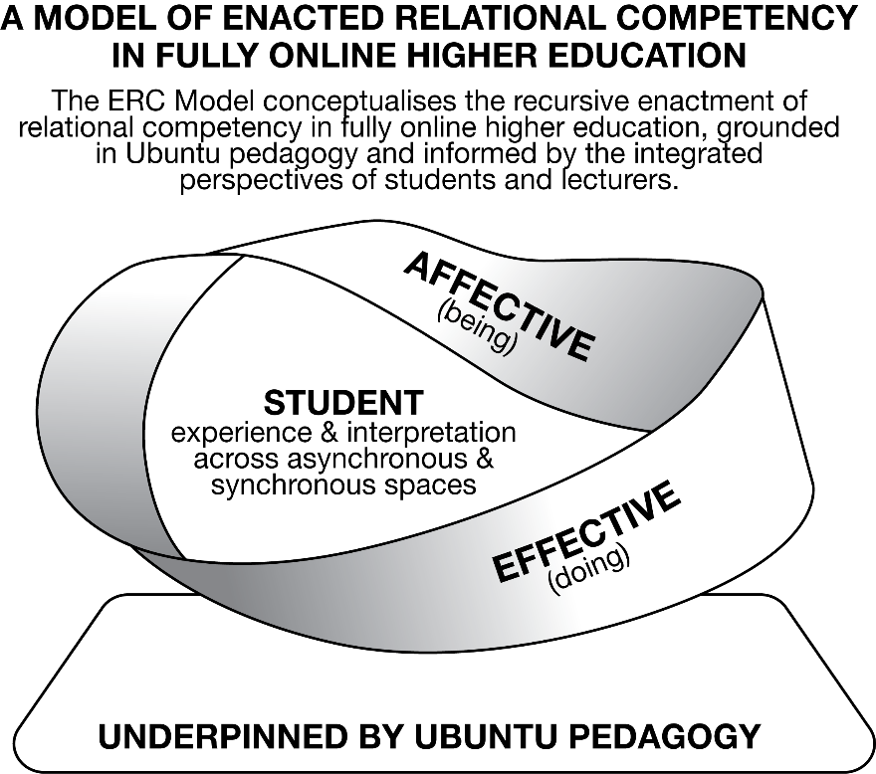
To represent this interconnectedness, the Möbius strip is introduced as the central metaphor. With its continuous, single surface, the Möbius form reflects how relational competency loops between affective and effective dimensions, and between intention and interpretation, without clean separations. Its continuous surface captures how practical elements such as clarity, structure, and responsiveness, loop seamlessly with emotional elements such as empathy, warmth, and presence, so that neither can be disentangled. Relational competency in this context is understood as an ongoing movement between effective and affective practices, visible in both synchronous and asynchronous online spaces (the in-between). The enacted relational competency model is intended as a generative and reflective conceptualisation of relational practice rather than a prescriptive framework of behaviours.
Enacted Relational Competency in Fully Online Higher Education
Implications
Theoretical Contribution
The study extends current scholarship on educator–student relationships in online higher education by conceptualising relational competency as a lived, enacted capability realised through small, intentional practices across both asynchronous and synchronous online spaces. While existing relational scholarship has tended to privilege immediacy and real-time interaction (Aspelin, 2014; Segerby & Aspelin, 2023), the findings show that much of the relational work in fully online learning occurs in the in-between moments of asynchronous engagement. These everyday practices carry relational meaning because they help students feel seen, supported, and recognised even outside live interaction. The enacted relational competency model therefore extends existing conceptualisations of relational competency by positioning it as an ongoing practice shaped by values, context, and everyday interactions rather than as a set of interpersonal attributes or isolated teaching behaviours.
Contribution to Open and Distance Learning Scholarship
The study also contributes to online and distance education scholarship by demonstrating how relational competency is enacted within predominantly asynchronous learning environments where students rely heavily on institutional systems and educator practices for connection and support. The findings show that relational competency is shaped by the contextual realities of online students, many of whom balance employment, caregiving, and study, and who interpret fairness, dignity, and responsiveness as central to feeling relationally supported. Lecturers, in turn, enacted relational competency by responding intentionally to these realities and humanising online learning spaces. Within the South African context, these findings resonate with scholarship discussing dignity, recognition, and shared humanity in educational practice (Jansen, 2024; Ngubane & Makua, 2021; Sevnarayan, 2022), reinforcing the contextual dimensions of relational competency in open and distance learning.
Practical Implications
Rather than prescribing behaviours, the enacted relational competency model offers a generative framework for recognising and reflecting on the relational dimensions of online teaching. It positions relational competency as something that can be intentionally enacted, recognised, and developed through everyday teaching practices. This has implications for online lecturer development, suggesting that professional learning should extend beyond technical system training to include relational aspects of online teaching such as communication, responsiveness, feedback practices, and creating more human online learning environments. The model may also support reflective practice by providing educators with a shared language for recognising the small relational actions that shape students' experiences of connection, support, and belonging.
Limitations and Future Research
As with all interpretivist case-based research, the study’s insights are shaped by its context and methodological boundaries. Conducted within a single institutional site, the modest student response rate reflects the voluntary nature of the survey rather than an attempt at representativeness. The purposive selection of lecturers as exemplars of relational practice also means the findings prioritise depth over breadth. These limitations do not diminish the study’s value; they point to avenues for further exploration.
Future research could examine how relational competency is enacted across different South African higher education contexts, including public universities and hybrid open and distance learning systems. It may also explore how the enacted relational competency model informs professional development, course design, and lecturer support structures, or it may examine how relational competency is enacted across different Global South contexts shaped by diverse cultural, infrastructural, and pedagogical conditions.
Conclusion
This paper conceptualised how relational competency is enacted within fully-online higher education through the combined perspectives of students and lecturers. Across both datasets, relational competency emerged through small but intentional practices that communicated care, responsiveness, clarity, and presence across online learning environments. Rather than being experienced only through synchronous interaction or emotional expressiveness, connection was often formed through the everyday in-between moments of online learning: timely replies, structured guidance, personalised communication, and visible lecturer engagement. These practices helped students feel recognised, supported, and connected within environments characterised by distance and asynchronous interaction.
The findings demonstrate that relational competency cannot be reduced to isolated interpersonal behaviours or teaching techniques. Lecturers described relationship-building as grounded in empathy, attentiveness, and responsiveness to students’ contexts and experiences. Students, in turn, interpreted relational competency not only through warmth, but also through fairness, consistency, flexibility, and clear communication. Relational competency therefore emerged as both affective and effective, enacted through practices that simultaneously supported learning and conveyed care.
The enacted relational competency model developed in this study reflects the recursive and interwoven nature of relational practice in fully online education. Drawing on Ubuntu pedagogy, the model positions relational competency within an ethic of care, dignity, and interconnectedness, offering a locally grounded yet globally relevant extension to existing relational and online learning frameworks. By emphasising asynchronous engagement, micro-practices, and the interplay between lecturer intention and student interpretation, the model contributes a conceptualisation of connection-building within predominantly online learning environments.
Ultimately, this paper argues that relational practice is not peripheral to online teaching, but central to how meaningful online learning is experienced and sustained. As online and distance education continues to expand, there is a need to move beyond viewing relational work as an innate personal quality or an optional extra. The findings suggest that relational competency is not something lecturers have; it is something they intentionally enact, guided by their values and expressed through everyday online practices.
Disclosure Statement
The authors acknowledge that no financial or non-financial interest has arisen from the direct applications of our research and there are no relevant competing interests to declare.
References
Acharya, A. S., Prakash, A., Saxena, P., & Nigam, A. (2013). Sampling: Why and how of it. Indian Journal of Medical Specialties, 4(2), 330–333.
Aires, L., Maia, S. M., & Carneiro, A. C. (2022). Distance educational relationship and senses of belonging: The voices of students. Digital Education Review, 42, 101–117. https://doi.org/10.1344/der.2022.42.101-117
Aspelin, J. (2014). Beyond individualised teaching: A relational construction of pedagogical attitude. Education Inquiry, 5(2), 233–245. https://doi.org/10.3402/edui.v5.23926
Aspelin, J. (2017). We can recite it in chorus now!: An interactionist approach to the teacher–student relationship and teachers’ relational competence. Classroom Discourse, 8(1), 55–70. https://doi.org/10.1080/19463014.2016.1271991
Aspelin, J. (2020). Teaching as a way of bonding: A contribution to the relational theory of teaching. Educational Philosophy and Theory, 53(6), 588–596. https://doi.org/10.1080/00131857.2020.1798758
Aspelin, J. (2022). Microscopic relational analysis: A method for researching the teacher–student relationship. International Journal of Research & Method in Education, 46(1), 56–69. https://doi.org/10.1080/1743727X.2022.2042244
Aspelin, J., & Eklöf, A. (2023). In the blink of an eye: Understanding teachers’ relational competence from a micro-sociological perspective. Classroom Discourse, 14(1), 69–87. https://doi.org/10.1080/19463014.2022.2072354
Aspelin, J., & Jönsson, A. (2019). Relational competence in teacher education: Concept analysis and report from a pilot study. Teacher Development, 23(2), 264–283. https://doi.org/10.1080/13664530.2019.1570323
Aspelin, J., Östlund, D., & Jönsson, A. (2020). “It means everything”: Special educators’ perceptions of relationships and relational competence. European Journal of Special Needs Education, 36(5), 671–685. https://doi.org/10.1080/08856257.2020.1783801
Aspelin, J., & Segerby, C. (2024). University teacher’s relational competence in online teaching: A microscopic relational analysis. Seminar.net, 20(1), 1–19. https://doi.org/10.7577/seminar.5711
Bingham, C., & Sidorkin, A. (2004). No education without relation. Peter Lang.
Braun, V., & Clarke, V. (2006). Using thematic analysis in psychology. Qualitative Research in Psychology, 3(2), 77–101. https://doi.org/10.1191/1478088706qp063oa
Braun, V., & Clarke, V. (2019). To saturate or not to saturate? Questioning data saturation as a useful concept in thematic analysis and sample-size rationales. Qualitative Research in Sport, Exercise and Health, 13(2), 201–216. https://doi.org/10.1080/2159676X.2019.1704846
Burtis, M., & Quinn, J. (2022). An introduction to designing for care and toward a critical instructional design. Hybrid Pedagogy. https://hybridpedagogy.org/an-introduction-to-designing-for-care-and-toward-a-critical-instructional-design/
Cholewinski, M. (2009). An introduction to constructivism and authentic activity. Journal of Educational Enquiry, 5, 283–316.
Daniels, H. (2001). Vygotsky and pedagogy. Routledge. https://doi.org/10.4324/9780203469576
Felten, P., & Lambert, L. M. (2020). Relationship-rich education: How human connections drive success in college. Johns Hopkins University Press.
Garrison, D. R., Anderson, T., & Archer, W. (1999). Critical inquiry in a text-based environment: Computer conferencing in higher education. The Internet and Higher Education, 2(2–3), 87–105. https://doi.org/10.1016/S1096-7516(00)00016-6
Gourlay, L. (2021). There is no ‘virtual learning’: The materiality of digital education. Journal of New Approaches in Educational Research, 10(1), 57–66. https://doi.org/10.7821/naer.2021.1.649
Gourlay, L., Campbell, K., Clark, L., Crisan, C., Katsapi, E., Riding, K., & Warwick, I. (2021). Engagement discourses, relationality and the student voice: Connectedness, questioning and inclusion in post-Covid digital practices. Journal of Interactive Media in Education, 2021(1). https://doi.org/10.5334/jime.655
Greene, J. C. (2007). Mixed methods in social inquiry. Jossey-Bass.
Hagenauer, G., Mühlbacher, F., & Ivanova, M. (2023). “It’s where learning and teaching begins – is this relationship” —Insights on the teacher–student relationship at university from the teachers’ perspective. Higher Education, 85(4), 819–835. https://doi.org/10.1007/s10734-022-00867-z
Hlatshwayo, M. N., & Shawa, L. B. (2020). Towards a critical re-conceptualisation of the purpose of higher education: The role of Ubuntu-Currere in re-imagining teaching and learning in South African higher education. Higher Education Research & Development, 39(1), 26–38. https://doi.org/10.1080/07294360.2019.1677504
Ivankova, N. V. (2015). Mixed methods applications in action research. Sage.
Jamieson, S. (2004). Likert scales: How to (ab)use them. Medical Education, 38(12), 1217–1218. https://doi.org/10.1111/j.1365-2929.2004.02012.x
Jansen, J. (2024, November 21). A loveless education deters pupils from learning. Jonathan Jansen.
Juul, J., & Jensen, H. (2010). Od poslušnosti do odgovornosti [From obedience to responsibility]. Didactica Slovenica, 25(3–4), 94–110.
Lincoln, Y. S., & Guba, E. G. (1985). Naturalistic inquiry. Sage.
Madhav, N., & Baron, P. (2022). Curriculum transformation at a private higher educational institution: An exploratory study on decolonisation. SOTL in the South, 6(3), 26–48. https://doi.org/10.36615/SOTLS.V6I3.267
Malterud, K., Siersma, V. D., & Guassora, A. D. (2016). Sample size in qualitative interview studies: Guided by information power. Qualitative Health Research, 26(13), 1753–1760. https://doi.org/10.1177/1049732315617444
Matadi, M. T., & Uleanya, C. (2022). Impact(s) of quality assurance requirements for private higher education institutions in South Africa. The Journal of Quality in Education, 12(20), 1–20. https://doi.org/10.37870/joqie.v12i20.323
McChesney, K., & Aldridge, J. M. (2019). Weaving an interpretivist stance throughout mixed methods research. International Journal of Research & Method in Education, 42(3), 225–238. https://doi.org/10.1080/1743727X.2019.1590811
Miles, M. B., Huberman, A. M., & Saldaña, J. (2014). Qualitative data analysis: A methods sourcebook (3rd ed.). Sage.
Moore, M. G. (2018). The theory of transactional distance. In M. G. Moore & W. C. Diehl (Eds.), Handbook of distance education (4th ed., pp. 32–46). Routledge.
Mpungose, C. B. (2020). Emergent transition from face-to-face to online learning in a South African university in the context of the Coronavirus pandemic. Humanities and Social Sciences Communications, 7, Article 113. https://doi.org/10.1057/s41599-020-00603-x
Ngubane, N., & Makua, M. (2021). Intersection of Ubuntu and social justice. Transformation in Higher Education, 6, 1–8. https://doi.org/10.4102/the.v6i0.113
Noddings, N. (2005). The challenge to care in schools: An alternative approach to education (2nd ed.). Teachers College Press.
Segerby, C. (2022). Exploring how a university mathematics teacher’s digital relational competence can be manifested: A micro-analytical study. Education Sciences, 12(4), 257. https://doi.org/10.3390/educsci12040257
Segerby, C., & Aspelin, J. (2023). How is teachers’ relational competence manifested in online higher education contexts? International Educational Research, 6(2), 35–54. https://doi.org/10.30560/ier.v6n2p35
Sevnarayan, K. (2022). “Your voice counts”: Understanding how online student evaluations encourage lecturers’ pedagogies during the COVID-19 pandemic. Journal of Pedagogical Sociology and Psychology, 4(2), 86–99. https://doi.org/10.33902/JPSP.202218458
Shannon, C., & Clarke, D. (2022). How teacher presence engages and supports online female postgraduate students at an Australian regional university. ASCILITE Publications. https://doi.org/10.14742/apubs.2022.98
Stake, R. E. (1995). The art of case study research. Sage.
Sundani, N., & Mamkhere, J. (2021). The relationship between students and lecturers: A case of selected private higher education institutions. Cogent Education, 8(1), 1873200.
van den Berg, G. (2023). Towards a theoretical framework for teaching and learning in online distance education. In F. R. Aluko & D. Coetzee (Eds.), Does distance education in the developing context need more research? Building practice into theory (Vol. 1, pp. 41–79). ESI Press.
van Dorresteijn, C., Fajardo-Tovar, D., Pareja Roblin, N., Cornelissen, F., Meij, M., Voogt, J., & Volman, M. (2025). What factors contribute to effective online higher education? A meta-review. Technology, Knowledge and Learning, 30(1), 171–202. https://doi.org/10.1007/s10758-024-09750-5
Vidmar, M., & Kerman, K. (2016). The development of teacher's relational competence scale: Structural validity and reliability. Solsko Polje, 27, 63–78.
Vygotsky, L. S. (1978). Mind in society: The development of higher psychological processes. Harvard University Press.
Vygotsky, L. S. (1997). The historical meaning of the crisis in psychology: A methodological investigation. In R. W. Rieber & J. Wollock (Eds.), The collected works of L. S. Vygotsky: Problems of the theory and history of psychology (Vol. 3, pp. 233–344). Plenum Press.
Walsh, C., Bragg, L. A., Heyeres, M., Yap, A., & Ratcliff, M. (2024). A systematic literature review of online academic student support in higher education. Online Learning, 28(2). https://doi.org/10.24059/olj.v28i2.3954
Wiklund-Engblom, A. (2018). Digital relational competence: Sensitivity and responsivity to needs of distance and co-located students. Seminar.net, 14(1), 1–14. https://doi.org/10.7577/seminar.2979
Yende, S. J. (2023). Emerging trends in South African higher education: A critical analysis of distance learning modalities in music. Progressio, 44, 1–20.
Yin, R. K. (2018). Case study research and applications: Design and methods (6th ed.). Sage.
Image Descriptions
Figure 1 Image Description: A Möbius strip illustrates a continuous, recursive loop between affective (being) and effective (doing). The student experience and interpretation across asynchronous and synchronous spaces is the central focus of this process and rests on the conceptual foundation of Ubuntu pedagogy.